Introduction: Things to Do in Jaisalmer
There’s something about Jaisalmer that no other city in India quite replicates. You step off the train or drive in through a flat desert highway, and within minutes you’re staring at a golden sandstone fort rising out of the sand like it grew there naturally. The city doesn’t ease you in slowly – it hits you all at once with color, history, dust, and camel bells.
Most people come to Jaisalmer thinking the desert is the main attraction. And yes, the Sam Sand Dunes experience is something you’ll talk about for years. But the city itself has far more going on – hidden havelis with jaw-dropping carved facades, a haunted ghost village, a lake that shouldn’t logically exist in the middle of the Thar, and food that you genuinely won’t find anywhere else.
This guide covers everything – things to do in Jaisalmer that are worth your time, things that are often skipped, how to pace your days, what to eat, when to go, and a few practical tips to make the whole trip smoother.
Why Jaisalmer Should Be on Every Traveler’s List
Jaisalmer isn’t just a pit stop on a Rajasthan trip. It’s a destination in its own right, and it rewards travelers who slow down and actually look around rather than rushing through a checklist. The city sits deep in the Thar Desert, roughly 100 km from the Pakistan border – which adds a strange, frontier-town quality to the place that you can’t really explain without experiencing it.
Quick Overview of Jaisalmer
- Location: Western Rajasthan, Thar Desert
- Known As: The Golden City, Sonar Nagri
- Best Time to Visit: October to March
- Ideal Trip Duration: 3 to 4 days minimum
- Key Highlights: Living fort, desert safaris, havelis, ghost village, folk culture
Top Historical and Cultural Things to Do in Jaisalmer

Explore Jaisalmer Fort (Sonar Quila)
This is where every visit to Jaisalmer should start. Jaisalmer Fort, locally called Sonar Quila or the Golden Fort, was built in 1156 AD by Rawal Jaisal and is one of the few fully preserved and actively inhabited forts in the world. About 3,000 people still live inside the fort walls today – running shops, guesthouses, restaurants, and temples within the same ancient sandstone structure.
The fort glows gold in the afternoon sun, which is partly how the city got its name. Entering through its four massive gates leads you into a maze of narrow lanes, carved merchant havelis, and open courtyards. It’s easy to lose a full morning just wandering here.
Entry Fee: ₹50 (Indians) | ₹250 (Foreign Nationals)
Timings: 9 AM – 5 PM
Best Time to Visit: Early morning for fewer crowds and better light
Jain Temples Inside the Fort
Seven intricately carved Jain temples from the 15th and 16th centuries sit within the fort complex. They’re made entirely from yellow sandstone, and the level of detail in the carvings – lotus patterns, figures, and geometric motifs – is exceptional. Don’t rush through these.
Maharaja’s Palace
A seven-story palace built partly atop the Hawa Pol (the fort’s fourth gate) includes the beautifully decorated Rang Mahal, mirror work interiors, and a rooftop that offers one of the best 360-degree views over Jaisalmer city. A paid audio guide in six languages is included with the entry ticket.
Visit Patwon Ki Haveli
Just outside the fort walls, Patwon Ki Haveli is actually a cluster of five interconnected havelis built by a wealthy merchant family in the 19th century. The carved sandstone facades are extraordinarily detailed – honeycomb lattice windows, ornate balconies, and floral motifs that took decades to complete.
What makes this stand out from the fort is how undisturbed it feels. It doesn’t get the same volume of visitors, so you can actually take your time here.
Entry Fee: ₹100 approximately
Time Needed: 45 to 60 minutes
Salim Singh Ki Haveli
This one has a distinctive peacock-shaped top that makes it unmistakable on the Jaisalmer skyline. Salim Singh Ki Haveli was built by a prime minister of Jaisalmer in the 18th century. The architecture is unusual compared to the other havelis – its top floor extends slightly outward, giving it an almost ship-like appearance.
Nathmal Ki Haveli
A lesser-visited but genuinely impressive haveli where the left and right halves of the building were constructed by two different craftsmen brothers – independently but symmetrically. The differences between the two halves, if you look closely enough, are what make it interesting.
Bada Bagh – Royal Cenotaphs
About 6 km north of Jaisalmer, Bada Bagh is a garden complex housing the royal cenotaphs (chhatris) of Jaisalmer’s Maharajas. Each chhatri is carved with a mounted figure of the king it honors. The location catches particularly beautiful golden light at sunset, and on a clear evening the view here is one of the more serene things Jaisalmer offers.
Entry Fee: ₹50
Best Time: Late afternoon, 30 minutes before sunset
Desert Adventures – Must-Do Experiences in Jaisalmer
Sam Sand Dunes
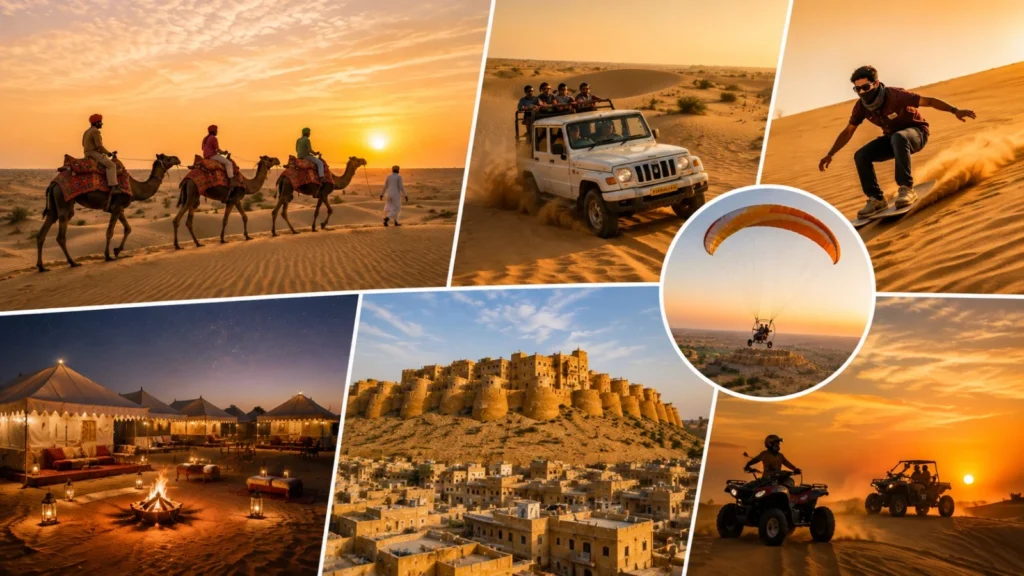
About 40 km west of the city, Sam Sand Dunes is the centerpiece of the Jaisalmer desert experience. The dunes here are genuine – large, sweeping, and golden – not the small rolling hills you sometimes get at touristy desert spots elsewhere.
Most visitors time their arrival for the late afternoon to catch sunset over the dunes. The light between 5 and 6 PM turns everything a deep amber and bronze that honestly doesn’t need a filter.
Camel Safari
A camel safari across Sam Sand Dunes is the slow version of the desert experience – literally. The pace of a camel ride gives you time to actually look around, and the slightly elevated vantage point makes for better photographs across the dune landscape. Most safaris run for 30 minutes to an hour and are often combined with a sunset viewing stop.
Jeep Safari
If the camel safari sounds too slow or the idea of sitting on a camel for an hour doesn’t appeal, jeep safaris are available across the same dunes. They’re faster, bumpier, and better for covering more ground. Many travelers do both – jeep out to a further point and camel back.
Desert Camp Stay and Folk Performances
Spending a night at a desert camp near Sam Sand Dunes is the kind of experience that stays with you. The better camps offer proper Swiss tents with proper beds, attached bathrooms, and meals – not makeshift setups. After dinner, most camps organize folk dance and music performances – kalbeliya dance, folk songs, puppet shows – which run for an hour or so under an open desert sky.
The real highlight is after the performance wraps up: the silence, the stars, and the absence of any light pollution. City dwellers rarely get this combination.
Offbeat Things to Do in Jaisalmer
Visit Kuldhara Abandoned Village
Around 18 km from Jaisalmer city, Kuldhara is a village that was abandoned overnight in the 19th century. Roughly 1,500 Paliwal Brahmin families left simultaneously, reportedly to escape the tyranny of a local minister, and the village has remained empty ever since.
The ruins of the sandstone houses, temples, and wells are eerily well-preserved. It’s a genuinely fascinating place, even without the ghost stories attached to it – though those don’t hurt if you enjoy a bit of mystery.
Entry Fee: ₹10
Best Time: Morning or late afternoon
Gadisar Lake – Sunrise and Boating
Gadisar Lake was built by the founder of Jaisalmer in the 12th century as a water reservoir for the city, which tells you something about how far back the history of water management in this desert city goes.
Today the lake is surrounded by temples, carved gateways, and small ghats that are ideal for early morning walks. Pedal boat rides are available for around ₹100 per person, and birdwatching here in the winter months is genuinely good. The Rajasthan government has also installed a laser water show at the lake in recent years, depicting the story of Jaisalmer’s founding.
Best Time to Visit: Sunrise or early morning
Tanot Mata Temple
At about 120 km from Jaisalmer – roughly a 2.5 hour drive each way – Tanot Mata Temple is more of a half-day excursion than a quick stop. The temple is famous for surviving over 1,000 bomb blasts during the 1965 and 1971 India-Pakistan wars without damage. Unexploded shells collected from the area are displayed in a small museum on the premises.
It’s maintained by the Border Security Force and sits very close to the Pakistan border. You’ll need to pass through a checkpoint, and wandering beyond designated areas is not permitted.
Longewala War Memorial
On the way to Tanot, the Longewala War Memorial commemorates the 1971 battle where a small Indian Army contingent held off a much larger Pakistani force for an entire night until air support arrived. The movie Border was based on this battle. The memorial displays captured Pakistani tanks, artillery, and military equipment that still sit on the sand as they were left.
Desert National Park
Covering over 3,000 sq km, the Desert National Park near Jaisalmer is home to the Great Indian Bustard – one of the world’s heaviest flying birds and critically endangered. The park also has blackbuck, chinkara (Indian gazelle), desert fox, and sand grouse. Winter is the best time for wildlife spotting here.
Akal Wood Fossil Park
About 17 km from Jaisalmer, this is one of those places that catches people by surprise. Akal Wood Fossil Park has fossilized tree trunks estimated to be around 180 million years old – from a time when this desert was covered in forest. It’s a short visit but genuinely unlike anything else in the city.
Things to Do in Jaisalmer for Couples

Jaisalmer works very well as a romantic destination, mainly because of the combination of heritage, desert, and unhurried pace. For couples specifically, the desert camp overnight stay is the standout experience – private tent setups, dinner under the stars, and folk performances make for a memorable evening.
Gadisar Lake at sunrise, a heritage hotel with a fort view rooftop, and a slow evening walk through the havelis are worth adding to the plan as well.
Things to Do in Jaisalmer for Families
Families traveling with kids tend to enjoy the desert activities the most – camel rides, the jeep safari, and the folk dance performances at camp. The Longewala War Memorial and the Jaisalmer War Museum (on the Jodhpur highway) appeal strongly to older children. Kuldhara’s mystery element works well too, since kids tend to find abandoned places far more interesting than ancient architecture.
Best Food to Try in Jaisalmer
Jaisalmer’s food scene is smaller than Jaipur or Jodhpur, but the local dishes are genuinely distinct. These are the ones worth tracking down.
Dal Baati Churma
The flagship dish of Rajasthan and the one you’ll see on every menu. Hard wheat bread balls baked in a tandoor, served with lentil dal and sweet churma (a crumbly dessert made from flour, ghee, and sugar). Restaurants near the fort do good versions of this.
Laal Maas
A slow-cooked mutton curry with dried red chilies and a rich, deeply spiced gravy. It’s the go-to non-vegetarian dish of Rajasthan and pairs best with bajra (millet) roti rather than plain rice.
Ker Sangri
A traditional desert vegetable dish made from dried berries and beans that grow in the Thar Desert – ingredients that aren’t available anywhere else in India. The flavor is smoky and tangy, and it’s genuinely different from anything you’d have tried before.
Makhania Lassi
Thick, rich, creamy lassi – closer in texture to shrikhand than a regular lassi. There are a couple of shops inside the fort that are famous specifically for this, and they’re worth the small detour.
Ghewar
A round, honeycomb-textured sweet made from flour and dipped in sugar syrup, often topped with rabri (sweetened condensed milk) and nuts. It’s especially popular during festival season but available year-round in Jaisalmer’s sweet shops.
Shopping in Jaisalmer – What and Where to Buy
Sadar Bazaar
The main market of Jaisalmer, within easy walking distance of the fort. Best for leather juttis (traditional footwear), mirror-work bags and pouches, camel leather goods, silver jewelry, and hand-block printed textiles. Prices here are generally better than in Jaipur for comparable items.
Bhatia Bazaar
One of Jaisalmer’s oldest markets, known for silk and cotton fabrics, embroidered dupattas, and antique items. If you’re looking for something older and more authentic-feeling than typical tourist souvenirs, this market is worth the extra effort.
Quick Shopping Tips:
- Bargaining is standard – first quoted prices are almost always negotiable
- Fixed-price government emporiums exist if you prefer to skip the haggling
- The lanes around Patwon Ki Haveli also have good craft shops that are often overlooked
Best Time to Visit Jaisalmer
October to March is the window most travelers aim for, and for good reason. Daytime temperatures stay between 15°C and 28°C, which is comfortable for walking around forts and desert dunes alike. December and January are peak season, so hotel prices go up noticeably.
April onwards gets genuinely brutal. Temperatures crossing 45°C aren’t unusual, and the desert amplifies the heat significantly.
Monsoon (July to September) brings very limited rainfall to Jaisalmer but does cool things down. Some travelers prefer this season for the emptier streets and lower prices, though a few outdoor experiences become less practical.
How to Reach Jaisalmer
By Air: Jaisalmer airport operates a limited number of domestic flights, mainly from Delhi and Mumbai. Jodhpur is the more practical air entry point – from there Jaisalmer is a 5-hour drive.
By Train: Several trains connect Jaisalmer directly to Jaipur, Jodhpur, Bikaner, and Delhi. The overnight train from Delhi or Jaipur is a common choice.
By Road: National Highway 11 connects Jodhpur to Jaisalmer in reasonable condition. Private cab hire for the entire Rajasthan trip makes this particularly convenient.
Jaisalmer Travel Tips
- Carry cash: Card acceptance is limited in local markets and smaller restaurants
- Stay hydrated: The dry desert air means you lose water faster than you realize, even when it doesn’t feel hot
- Book desert camp in advance: Good camps get fully booked in peak season (November to February), especially on weekends
- Bargain respectfully: Shops near tourist spots tend to start prices high; don’t be aggressive about it
- Early starts matter: Major sights like the fort and Amer see crowds build fast after 10 AM; start by 8 AM if you can
- Watch your belongings: Crowded market areas attract pickpockets; keep valuables in a front pocket or money belt
How A1 Classic Travels Can Help You Explore Jaisalmer
Jaisalmer is a city where local knowledge genuinely makes a difference – knowing which desert camp is actually worth the price, which route to Tanot is better at which time of year, or where to find a good Laal Maas that isn’t on a tourist menu. A1 Classic Travels brings that local familiarity to your trip planning.
- Customized Jaisalmer Tour Packages – Whether you’re coming for 2 days or 5, the itinerary is built around your pace and interests rather than a one-size-fits-all schedule.
- Reliable Car Rental Services – Sedans, SUVs, and luxury vehicles available for city transfers and longer excursions like the Tanot Temple run.
- Desert Safari and Camp Arrangements – Camel safaris, jeep safaris, and overnight desert camp bookings handled with vetted local operators.
- Hotel Booking Assistance – From budget guesthouses near the fort to heritage properties, recommendations are made based on your actual requirements and travel dates.
- End-to-End Travel Support – From arrival to departure, the team is reachable if plans change, which in desert travel they sometimes do.
Why Choose A1 Classic Travels?
The Jaipur base means deep familiarity with Rajasthan travel across all its cities – not just surface-level recommendations pulled from a website. Travelers who book through them tend to find the logistics side of the trip significantly less stressful, which frees up more attention for actually experiencing the places.
Planning a trip to Jaisalmer? A1 Classic Travels can help with customized tour packages, comfortable car rentals, hotel bookings, and desert safari arrangements. Contact us today to plan a seamless and memorable Golden City experience.
Conclusion
Jaisalmer is one of those rare travel destinations that genuinely delivers on its reputation. The fort is as impressive as photographs suggest, the desert at night is as quiet and vast as you’d hope, and the food is the kind of regional cooking that hasn’t been diluted for outside tastes.
The key to getting the most out of a visit here is not rushing it. Three to four days minimum gives you time to actually explore the fort lanes properly, make the Tanot excursion, spend a night in the desert, and still have a slow morning at Gadisar Lake before you leave.
Plan the timing right, book your desert camp ahead of peak season, and you’ll find that most of what makes this city special has nothing to do with a formal itinerary – it’s just being here.
Frequently Asked Questions
Jaisalmer Fort, Sam Sand Dunes, Patwon Ki Haveli, Gadisar Lake, and an overnight desert camp are the five experiences that cover the best of what the city offers for a first visit.
Three days is a reasonable minimum – one day for the city and havelis, one for the desert safari and overnight camp, and one for offbeat spots like Kuldhara and Bada Bagh.
Yes, Jaisalmer is generally considered one of the safer tourist cities in Rajasthan, with a strong tourism infrastructure and a relatively low-crime environment for visitors.
Late afternoon starting around 4 PM is ideal, as it allows you to ride through the dunes and reach a good viewpoint for the desert sunset.
Leather juttis, camel leather goods, mirror-work bags, hand-block printed textiles, silver jewelry, and wooden handicrafts are the most popular and authentic items to pick up.
Latest Post
- Jaipur to Pushkar Camel Fair 2026: Distance, Route, Fare & Complete Travel Guide
- Jaipur to Salasar Balaji: Complete Distance, Route & Travel Guide
- Jaipur to Vrindavan Distance: Complete Travel Guide
- Things to Do in Jaisalmer: The Complete Golden City Travel Guide
- Jaipur to Ranthambore Distance – Route, Travel Time, Taxi Fare & Complete Travel Guide