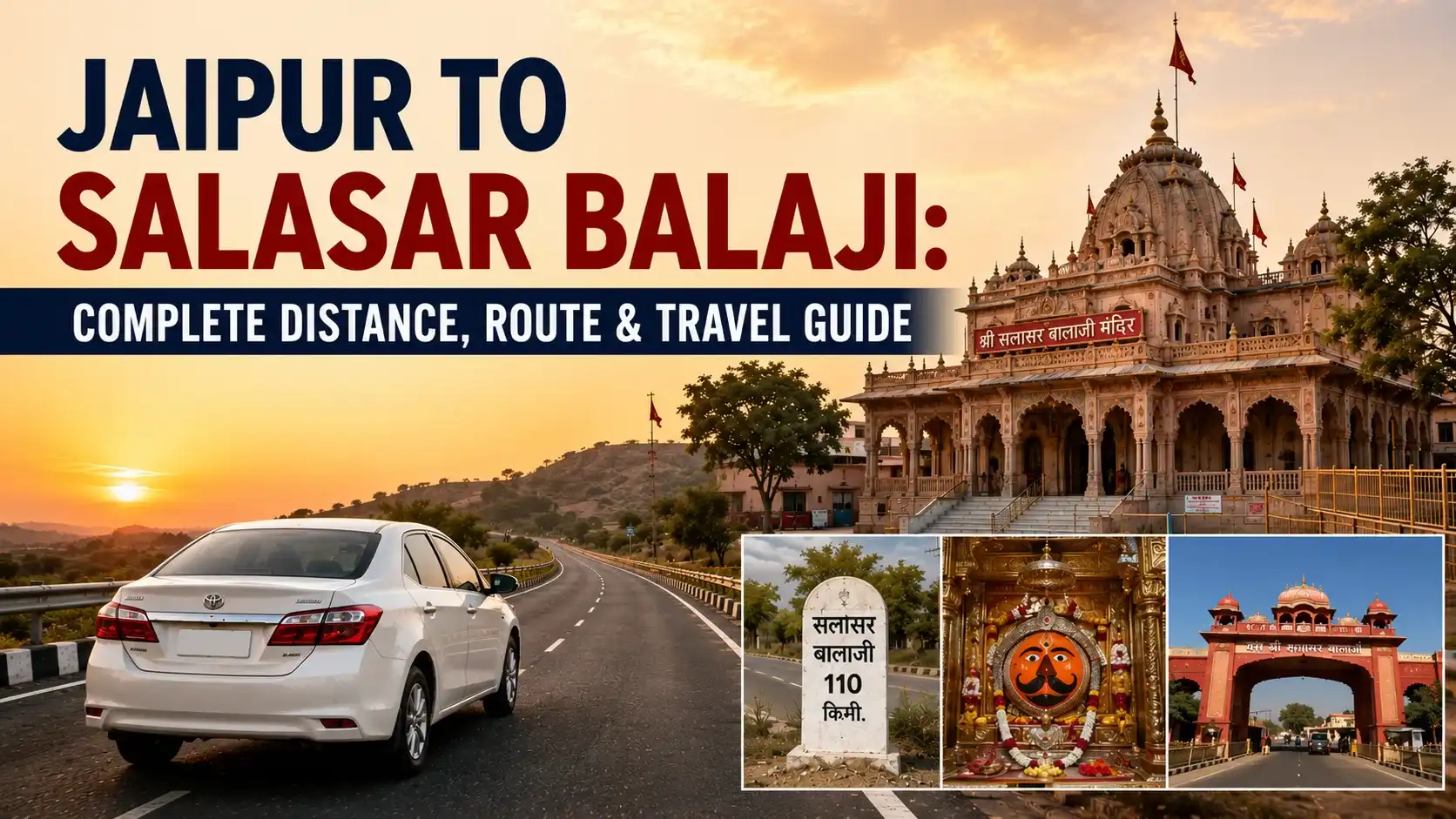
Introduction: Jaipur to Salasar Balaji
If you’re planning a trip from Jaipur to Salasar Balaji, you’re not alone. Salasar Balaji Temple is one of the most important Hanuman pilgrimage sites in Rajasthan, attracting devotees from Jaipur, Delhi and other parts of North India throughout the year. The Jaipur to Salasar Balaji distance is around 170 km by road, and the journey generally takes about 3.5 to 4 hours, depending on traffic, route conditions and stops along the way.
The journey is straightforward, but choosing the right route, planning your departure time, understanding the temple’s darshan schedule and considering festival crowds can make a significant difference. Many travellers also combine Salasar Balaji with Khatu Shyam Ji or Jeen Mata Temple, turning a simple temple visit into a complete pilgrimage trip.
Quick Answer
Jaipur to Salasar Balaji is approximately 170-175 km, and the drive takes around 3.5 to 4 hours by road via NH52, passing through Chomu, Sikar, Laxmangarh, and Fatehpur before reaching Sujangarh and Salasar. The temple is one of the most visited Hanuman shrines in North India, largely because the idol here is shown with a beard and moustache – a form found almost nowhere else. The route is comfortable for a same-day trip if you start early, and October to March remains the most practical travel window.
Key Facts Table
| Detail | Information |
| Distance from Jaipur | ~170-175 km |
| Travel time by road | 3.5-4 hours (non-peak traffic) |
| Main route | NH52 via Chomu → Sikar → Laxmangarh → Fatehpur → Sujangarh → Salasar |
| Temple location | Salasar town, Churu district, Rajasthan |
| Temple timings | 4:00 AM – 10:00 PM |
| Nearest railway stations | Sujangarh (~24-28 km) and Churu (~52 km) |
| Nearest airport | Jaipur International Airport |
| Best time to visit | October to March |
| Chaitra Purnima 2026 | April 1-2 |
| Ashwin Purnima 2026 | October 25-26 |
| Busiest weekly days | Tuesday and Saturday |
Why Salasar Balaji Draws So Many Visitors from Jaipur
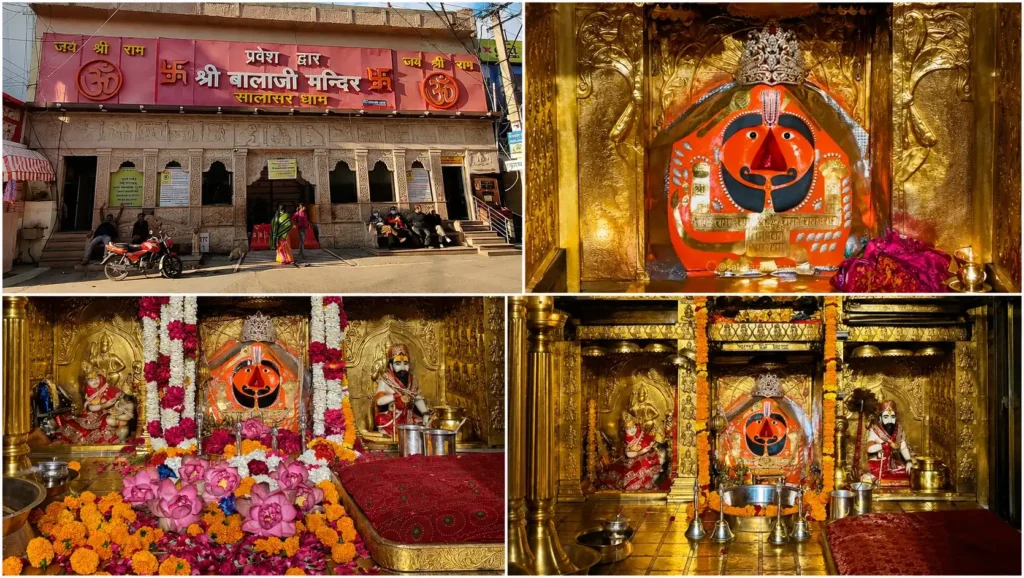
Salasar Balaji isn’t just another Hanuman temple on the pilgrim circuit. What sets it apart is the idol itself – depicted with a beard and moustache, a representation devotees describe as unlike any other Hanuman murti they’ve seen. The idol is considered Swayambhu, meaning it wasn’t sculpted but discovered, which adds another layer of significance for visiting pilgrims.
The temple is also part of a wider religious circuit that includes Khatu Shyam Ji and Jeen Mata Temple, both within a short driving distance of Salasar. This is why many travellers from Jaipur don’t treat this as a single-temple trip – they plan it as a two-or-three-stop pilgrimage circuit, which changes how much time and what kind of transport you actually need.
Distance, Route Waypoints & Travel Time from Jaipur
The road distance between Jaipur and Salasar Balaji is roughly 170-175 km, and under normal traffic conditions, the journey takes 3.5 to 4 hours. The most-used route runs: Jaipur → Chomu → Sikar → Laxmangarh → Fatehpur → Sujangarh → Salasar.
The stretch from Jaipur to Sikar is a smooth, well-maintained four-lane highway suited to any vehicle type. Past Sikar, toward Laxmangarh and Salasar, the road narrows to a two-lane state highway – still well-maintained overall, but with occasional speed breakers near smaller towns, so a bit more caution is needed on that final stretch.
Actual travel time depends on a few practical factors:
- Departure time – leaving before 6:00-6:30 AM keeps you ahead of both traffic and daytime heat.
- Season – during Chaitra Purnima and Ashwin Purnima, expect noticeably slower movement near Salasar due to festival traffic.
- Mode of transport – a private taxi with an experienced driver is typically faster than a shared bus, which makes several stops along the way.
- Fuel stops – petrol pumps are frequent up to Sikar; beyond that, fuel availability drops, so it’s worth topping up your tank in Sikar before continuing.
For a comfortable one-day round trip, most travellers leave Jaipur by 6:00-7:00 AM, reach Salasar by 10:00-10:30 AM, and start the return journey by early afternoon.
Best Routes from Jaipur to Salasar Balaji
| Route | Via | Distance | Approx. Time | Notes |
| Route 1 (Most used) | Jaipur → Chomu → Sikar → Laxmangarh → Fatehpur → Sujangarh → Salasar | ~170-175 km | 3.5-4 hrs | NH52 throughout, best road quality |
| Route 2 | Jaipur → Renwal → Sikar → Salasar | ~175 km | 3.5-4 hrs | Slightly longer, fewer diversions |
| Route 3 (Combined circuit) | Jaipur → Khatu Shyam Ji → Salasar | ~190 km | 4.5-5 hrs | Ideal for covering both temples in one trip |
Route 1 remains the default choice for most pilgrims because it has the fewest diversions and reasonably frequent rest stops along the way.
How to Reach Salasar Balaji from Jaipur: Mode-Wise Comparison
| Mode | Comfort | Travel Time | Best Suited For |
| Private Taxi/Cab | High | 3.5-4 hrs | Families, elderly travellers, flexible timing |
| State/Private Bus | Moderate | 4.5-5 hrs | Budget and solo travellers |
| Self-Drive Car | High | 3.5-4 hrs | Travellers comfortable with highway driving |
| Train + Local Taxi | Moderate | 5-6 hrs (with transfers) | Those who prefer rail but don’t mind a connecting leg |
By Road: The most direct option, since it avoids transfers entirely and lets you control your own schedule.
By Train: The nearest railway stations are Sujangarh (roughly 24-28 km from the temple) and Churu (roughly 52 km), both on the Jaipur-Bikaner rail line. From either station, you’d continue by local taxi or shared auto – workable, but with more waiting time built in compared to a direct road trip.
By Air: For pilgrims flying in from other states, Jaipur International Airport is the natural entry point, from where the road journey continues as described above.
What the Trip Roughly Costs
Exact fares change with fuel prices, vehicle type, and season, so treat these as planning ranges rather than fixed numbers – always confirm current rates before booking:
- Private taxi (one-way, sedan): Moderate range, generally higher during Purnima fair periods due to demand.
- Private taxi (round trip, same-day): Usually more economical per km than booking two separate one-way trips.
- State/private bus: The cheapest option per person, especially for solo travellers.
- Toll charges: A few toll plazas fall along the NH52 corridor between Jaipur and Sikar; factor this into your fuel budget if self-driving.
- Fuel: Since availability drops noticeably beyond Sikar, filling up there before continuing avoids both cost surprises and range anxiety.
For a family or group of 4-5, a private taxi usually works out more practical than individual bus tickets once you factor in comfort, luggage, and flexible timing – especially if you’re combining Salasar with Khatu Shyam Ji.
Rajasthan Weather Along This Route, Month by Month
Since the drive itself is a few hours on open highway, weather along the route matters as much as the weather at Salasar:
| Months | Daytime Temp (approx.) | Travel Comfort |
| October – February | 15°C – 27°C | Best window; comfortable driving and darshan |
| March | 20°C – 32°C | Still manageable; early departure recommended |
| April – June | 30°C – 44°C | Harsh; highway drive best done before 9 AM or after 5 PM |
| July – September | 25°C – 35°C (humid, monsoon showers) | Roads generally fine but watch for waterlogging near Fatehpur-Sujangarh stretch during heavy rain |
If you must travel in summer, an early pre-dawn departure isn’t just about beating traffic – it genuinely makes the difference between a comfortable drive and a punishing one on this stretch.
Best Time to Visit Salasar Balaji from Jaipur
October to March offers the most comfortable travel conditions overall. If your priority is a peaceful, low-crowd darshan, avoid Chaitra Purnima and Ashwin Purnima. If you specifically want to experience the temple fair – the scale, the crowds, the devotional atmosphere – these are the exact dates to target, just with extra time built into your schedule.
Confirmed 2026 festival dates:
- Chaitra Purnima: April 1-2, 2026
- Ashwin Purnima (Sharad Purnima): October 25-26, 2026
Tuesdays and Saturdays also see noticeably higher footfall through the rest of the year, since both days hold particular significance for Hanuman devotees.
Things to Know Before You Go
- Dress code: Modest clothing is expected inside the temple; avoid sleeveless tops or shorts.
- Photography: Not permitted inside the sanctum sanctorum.
- Footwear counters: Available near the temple entrance for safekeeping.
- Parking: Reasonably ample near the temple, though it fills up fast during Purnima fairs – arriving early secures better parking, not just a shorter darshan queue.
- Coconut offering (nariyal bandhna): A common ritual – devotees tie a coconut while making a wish and return to untie it once fulfilled.
- Prasad: Available both inside the temple premises and from surrounding sweet shops.
Places to Visit Near Salasar Balaji
| Destination | Approx. Distance from Salasar |
| Khatu Shyam Ji Temple | ~55-60 km |
| Jeen Mata Temple | ~50 km |
| Rani Sati Temple (Jhunjhunu) | ~90 km |
| Sikar City | ~57 km |
A two-day trip covering Salasar Balaji and Khatu Shyam Ji together is one of the most common pilgrimage plans for travellers coming from Jaipur.
Where to Eat on the Way
Roadside dhabas serving chai, paratha, dal-baati, and basic Rajasthani thalis are common right through the route and make convenient rest stops. Laxmangarh, roughly 140 km from Jaipur and about 30-35 km before Salasar, is a well-known halting point where several travellers stop for a proper meal before the final stretch – useful to know if you’d rather eat before darshan than search for food once you reach the temple town. Inside Salasar itself, the eateries near the main temple gate serve simple, filling vegetarian thalis suited for pilgrims, though quality varies more than at the highway stops.
Where to Stay Near Salasar Balaji
- Dharamshalas – budget-friendly and located close to the temple, popular during festival periods.
- Guest houses and budget hotels – a step up in comfort with private rooms.
- Booking advice – during Chaitra Purnima and Ashwin Purnima, rooms fill up quickly, so booking at least a couple of weeks in advance is worth it. For a same-day trip from Jaipur, an overnight stay usually isn’t necessary.
Common Mistakes First-Time Visitors Make
- Leaving Jaipur too late – starting after 9 AM often means hitting both daytime heat and temple crowds together.
- Not checking the Purnima calendar – travellers unknowingly land on a mela day and get stuck in hours of extra traffic.
- Skipping fuel-up at Sikar – fuel stations thin out considerably past Sikar, and running low mid-route is avoidable.
- Wearing inappropriate clothing – some visitors are turned away or asked to cover up at the entrance, which basic planning avoids entirely.
Expert Tips for a Smooth Trip
- Start by 6:00-6:30 AM to stay ahead of both traffic and crowds.
- Fill your tank in Sikar – don’t rely on finding fuel past that point.
- Carry water and light snacks for the stretch between dhabas.
- If travelling during festival dates, build in at least an extra hour for slower movement near Salasar.
- Choose a private taxi over a bus if travelling with elderly family members or young children.
- Check crowd status a day before major fair dates so you can plan your darshan timing better.
Why Choose A1 Classic Travels for Your Jaipur to Salasar Balaji Trip
Planning this trip on your own is doable for a simple day visit – but pilgrimage travel comes with details that are easy to underestimate: festival-day traffic, temple crowd timing, road conditions on the narrower Sikar-to-Salasar stretch, and comfort for elderly or first-time travellers. This is where a locally experienced travel partner makes a real difference.
A1 Classic Travels operates out of Jaipur and has handled this route across both routine weekday visits and high-traffic Purnima fair periods, which means the timing and stop planning are based on actual on-ground experience rather than a generic map estimate.
What this means for you in practice:
- Route-experienced drivers – familiar with both the standard NH52 route and the combined Khatu Shyam Ji circuit, so timing estimates are realistic, not generic.
- Flexible scheduling – early-morning pickups arranged around your preferred darshan timing, not a fixed departure slot.
- Well-maintained, clean vehicles – suited for families, elderly pilgrims, and long highway stretches.
- Multi-temple trip planning – if you want to cover Salasar Balaji along with Khatu Shyam Ji or Jeen Mata Temple, the itinerary is planned as one trip instead of leaving you to coordinate transport separately for each stop.
- Transparent pricing – no last-minute surprises on fare, tolls, or waiting charges.
- Local, on-ground knowledge – from festival-day traffic patterns to which stretches slow down during peak season, the kind of detail that only comes from actually doing this route repeatedly, not from reading a map.
If you’d rather focus on the darshan and let someone else handle the driving, timing, and route planning, this is exactly the kind of trip A1 Classic Travels is built to manage – from pickup in Jaipur to drop-off back home.
FAQs
The Jaipur to Salasar Balaji distance is approximately 170–175 km by road via NH52. The journey generally takes around 3.5 to 4 hours, depending on traffic, road conditions and stops.
October to March is generally the most comfortable period for travelling from Jaipur to Salasar Balaji. For the temple fair experience, Chaitra Purnima and Ashwin Purnima are important dates to consider.
You can travel by private car, taxi or bus from Jaipur. A taxi is a convenient option if you want flexible departure timings, direct travel and the option to plan your return around darshan.
Yes, a Jaipur to Salasar Balaji one-day trip is possible. An early morning departure gives enough time for the journey, darshan and return to Jaipur on the same day.
Salasar Balaji Temple remains open daily from approximately 4:00 AM to 10:00 PM. Aarti is performed several times during the day, so checking the latest schedule before travelling is advisable.
Yes, many devotees combine Salasar Balaji and Khatu Shyam Ji in one pilgrimage itinerary. Proper route and timing planning is important because both temples can become crowded during festivals and special occasions.
The commonly used road route from Jaipur is via NH52, covering approximately 170–175 km. Starting early can help you avoid heavier traffic and reach Salasar with more time for darshan.
A Jaipur to Salasar Balaji taxi is a practical choice for families, senior citizens and groups who prefer door-to-door travel. It also gives you more flexibility for pickup, temple timings, waiting and the return journey.
Latest Post
- Jaipur to Pushkar Camel Fair 2026: Distance, Route, Fare & Complete Travel Guide
- Jaipur to Salasar Balaji: Complete Distance, Route & Travel Guide
- Jaipur to Vrindavan Distance: Complete Travel Guide
- Things to Do in Jaisalmer: The Complete Golden City Travel Guide
- Jaipur to Ranthambore Distance – Route, Travel Time, Taxi Fare & Complete Travel Guide