Somewhere between Chomu and Ringas, the road opens up and the mustard fields start showing up on both sides if you’re travelling in winter. That stretch alone tells you why this drive is one of the most popular short pilgrimages out of Jaipur. It’s close, it’s manageable in a single day, and it doesn’t demand the kind of planning a longer Rajasthan trip does.
At A1 Classic Travels, we’ve been running pilgrims, families, and solo devotees on this exact route out of Jaipur for years now, in everything from a compact sedan to a 17-seater tempo traveller during the Falgun Mela crowd. This guide puts together everything we’ve learned doing it, distance, routes, timings, costs, and the small details that actually matter once you’re on the road, not just the numbers you’d get from a map app.
A lot of what’s floating around online for this route is copy-pasted from one source to the next, which is why you’ll see wildly different distance figures on different sites. We’ve tried to sort that confusion out here, along with things that genuinely matter on the day of travel, what the last stretch into Khatu actually feels like, where the parking situation gets tight, and when it’s worth paying for VIP darshan versus just showing up early.
Quick Answer
Jaipur to Khatu Shyam distance is approximately 80 to 89 km by road, depending on which part of Jaipur you’re starting from and which route you take. The drive usually takes 1 hour 45 minutes to 2.5 hours, with the NH-52 route via Chomu and Ringas being the fastest and most commonly used.
Distance Summary
Here’s the thing nobody explains properly: the “80 vs 89 km” confusion isn’t an error, it’s just two different starting points and two different routes being quoted interchangeably across the internet. If you’re leaving from central Jaipur or the Sikar Road side (Vidhyadhar Nagar, VKI, Jhotwara), you’re closer to 80 km. If you’re starting from South Jaipur, Tonk Road, or Sitapura, you’ll add distance through the ring road connection, closer to 89 to 92 km. Both are correct, just for different starting points.
Quick Distance Table
| Route | Distance | Approx. Time | Best For |
| Via Chomu → Ringas (NH-52) | 80 to 89 km | 1h 45m to 2h | Central/North Jaipur, most travellers |
| Via Shahpura | 85 km | 2h | Scenic, less traffic, rural roads |
| Via Ring Road connector | 89 to 92 km | 2h to 2h 15m | South Jaipur, Tonk Road, Sitapura |
| Via Jaipur → Ringas Junction (train) + local | ~78 km (rail) + 18 km | 2.5h to 3.5h | Solo/budget travellers |
Travel Time
Under normal daylight traffic, a private car or taxi covers the distance in 1 hour 45 minutes to 2 hours. Add 20 to 30 minutes if you’re leaving Jaipur during morning office traffic (8 to 10 AM) or if you’re travelling on a weekend when the Ringas-Khatu stretch gets congested with pilgrim vehicles. During Shyam Ekadashi or Falgun Mela, this last 15 to 18 km stretch alone can eat up an extra hour because of parking queues and foot traffic near the temple.
Fast Facts
- Distance: 80 to 89 km (route dependent)
- Travel time: 1h 45m to 2.5h by road
- Nearest railway station: Ringas Junction, roughly 18 to 20 km from the temple
- State: Rajasthan, Sikar district
- Highway: NH-52 (four-lane, well maintained)
- Best months: October to March
- Temple deity: Khatu Shyam Ji (Barbarika), worshipped as Shyam Baba
Distance by Road
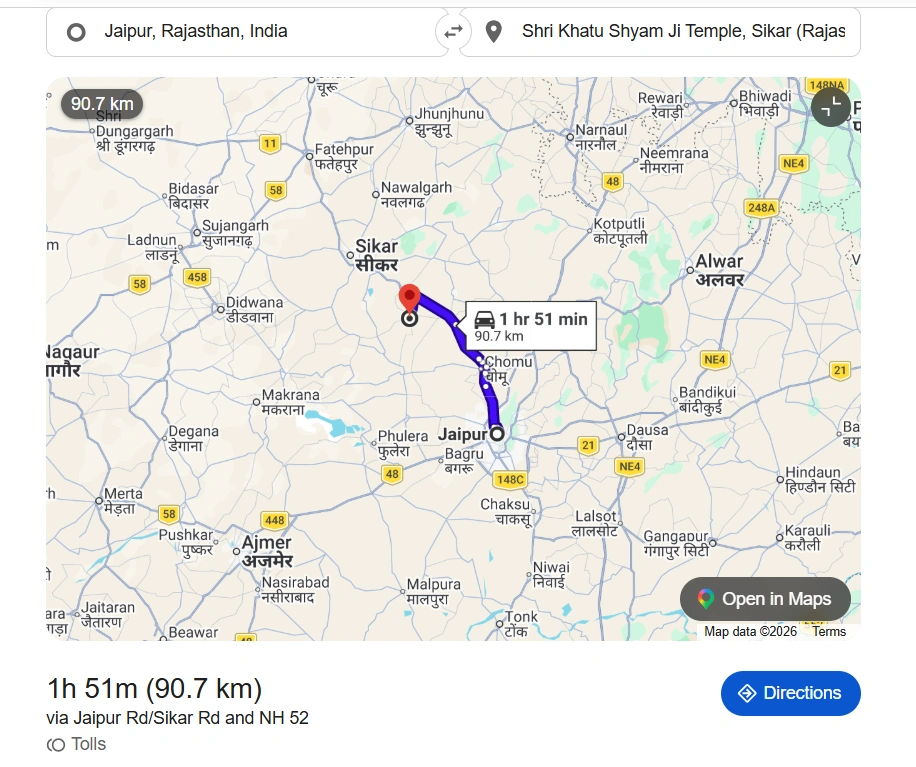
The road distance breaks down like this depending on the exact route:
- Via Sikar Road/NH-52 (Chomu → Ringas → Khatu): around 89 km, the most used route, mostly four-lane highway.
- Via Shahpura: around 85 km, a bit more scenic, passes through smaller towns, road is good but narrower in a couple of stretches.
- Via Ring Road (for South Jaipur starts): around 92 km, adds distance but saves you from cutting through the city center.
- Shortest possible reading (some inner-road combinations): as low as 80 km, though this isn’t always the fastest in terms of time because of village roads.
Honestly, for most travellers booking a cab with us, we default to the NH-52 route through Chomu and Ringas. It’s the one our drivers know best and it has the most fuel stations, dhabas, and mechanics along the way if something goes wrong.
Distance by Train
There’s no direct train station at Khatu Shyam itself. The nearest useful station is Ringas Junction, about 18 to 20 km from the temple. Jaipur to Ringas by rail runs roughly 78 km and takes about an hour to an hour and a half depending on the train. From Ringas, you’ll need a local taxi, shared jeep, or auto to cover the remaining distance, which usually takes another 30 to 45 minutes. This works well for solo travellers or students who don’t want to deal with driving and are fine with one transfer.
Distance by Flight
There’s no airport near Khatu Shyam. If you’re flying in, Jaipur International Airport is your entry point, and from there the distance to Khatu Shyam stretches to roughly 90 to 95 km depending on where in the temple town you’re headed, since the airport sits south of the city while Khatu is north. Budget close to 2 to 2.5 hours from the airport itself, a bit more than starting from central Jaipur.
Fastest Route
The NH-52 route via Chomu and Ringas is the fastest under normal conditions. Four lanes for most of the stretch, decent surface, and it’s the route local taxi drivers default to because it has the fewest surprises.
Shortest Route
Some inner-road combinations through Chomu clock in around 80 km, technically the shortest on distance. But shortest isn’t always fastest here, narrower roads and slower village stretches can eat up any time saved.
Google Maps Route
If you’re self-driving, search “Khatu Shyam Ji Temple” directly rather than “Khatu” as a town, since Google Maps sometimes routes through a longer village path if you just type the town name. The app-suggested route typically matches our NH-52 recommendation, Jaipur → Chomu → Ringas → Khatu, and it updates in real time for traffic, which is genuinely useful during festival weekends.
Alternative Routes
Besides the three main options above, some drivers use a Renwal-Chomu combination or cut through Kalwar Road if starting from far West Jaipur. These aren’t faster, just occasionally useful if there’s a road closure or accident reported on NH-52.
Route Map Explanation
Picture it as three legs. First, Jaipur to Chomu, about 32 km of mostly urban-to-semi-urban road with a fair bit of traffic near the Chomu circle itself. Second, Chomu to Ringas, roughly 30 km of proper four-lane highway, this is where you’ll make up time. Third, Ringas to Khatu, about 18 km on a narrower state highway (Danta Ramgarh Road) that gets congested close to the temple, especially the last 2 to 3 km where parking management kicks in.
Road Condition
Overall good. NH-52 is a well-maintained four-lane national highway for most of the Jaipur-Ringas stretch. The last leg from Ringas to Khatu is narrower, two-lane, but paved and manageable. Monsoon months (July to September) occasionally see waterlogging near low-lying patches close to Chomu, so add a buffer if you’re travelling during heavy rain.
Road Safety
Standard Rajasthan highway driving rules apply here, nothing unusual, but a few things are worth flagging. Watch for slow-moving tractors and cattle near village stretches, particularly around Shahpura and the Ringas-Khatu link road, these appear with almost no warning on blind curves. Night driving on the last leg isn’t recommended if you’re unfamiliar with the route, streetlighting thins out past Ringas and the road narrows without much warning. During winter, early morning fog can reduce visibility significantly on the open highway stretches between Chomu and Ringas, so if you’re leaving before sunrise for Mangala Aarti, keep speeds moderate and fog lights on if your vehicle has them.
Driving Tips
Fill up before Chomu if you’re on a tight schedule, fuel stations get busier near Ringas during festival season and lines form fast. Keep some cash for local parking near the temple since digital payment isn’t always reliable there, network drops are common exactly when you need to scan a QR code. If you’re driving yourself for the first time, downloading an offline map is worth the two minutes it takes, network coverage gets patchy in a few pockets between Ringas and Khatu, and there’s nothing worse than losing navigation on an unfamiliar turn. One more thing worth knowing, overtaking on the Shahpura route needs more patience than NH-52 since it’s narrower, don’t force a pass on a blind curve just to save thirty seconds.
Toll Plaza Information
There’s typically one toll point on the NH-52 stretch depending on the exact route taken. Budget roughly ₹50 to ₹100 one way for a sedan, tempo travellers pay a bit more. Keep FASTag active if you’re self-driving, it saves real time during the weekend rush when toll queues build up.
Fuel Stations
Regular fuel stations exist all along NH-52, spaced comfortably, you won’t run into a stretch longer than 15 to 20 km without one until you’re past Ringas. A couple of stations near Chomu also do basic mechanical checks, useful if you hear an odd noise on the way.
EV Charging Stations
EV charging infrastructure on this route is still limited but growing. A few fast-charging points exist near Jaipur city limits and on the outskirts toward Chomu, mostly at highway fuel plazas. If you’re driving an EV, it’s worth charging fully in Jaipur before departure since dedicated charging near Ringas or Khatu itself is minimal as of now, this is one area that’s changing fast so check current app-based charger maps closer to your travel date.
Food Stops
Baba Ka Dhaba, close to the temple, does a reliable dal baati churma thali. Along the highway itself, there are several dhabas near Chomu and Ringas serving standard North Indian and Rajasthani fare, parathas, dal, sabzi, the works. Most are open by 6 AM which works well for an early departure crowd.
Tea Stops
Small roadside tea stalls dot the Chomu-Ringas stretch, useful for a quick break every 40 minutes or so if you’re driving. Nothing fancy, but the chai is hot and the stops are quick.
Rest Stops
A few dhabas double as informal rest stops with basic washrooms, mostly clustered near Chomu and again just before Ringas. Not luxury facilities, but functional for a pilgrimage-style trip.
Best Time to Visit
October through March is genuinely the sweet spot, pleasant weather, comfortable driving, and it lines up with the Falgun Mela season if you’re planning around festivals. Summer (April to June) is doable but hot, an AC vehicle basically becomes mandatory. Monsoon has its own charm, green fields, cooler air, but factor in a slightly longer drive time for the occasional waterlogged patch.
Weather Guide
Winters (Nov-Feb) drop to around 8 to 12°C at night in this belt, carry a light jacket for early morning aarti visits, that predawn Mangala Aarti drive can feel genuinely cold with the windows down. Summers regularly cross 40°C by May-June, so plan your drive for early morning or evening if travelling that season, and make sure your vehicle’s AC is working properly before you leave, this isn’t a route you want to do in a non-AC car during peak summer. Monsoon brings moderate rainfall, not extreme, but enough to slow down the last leg occasionally, and it does bring out the greenery around Chomu and Shahpura in a way that’s genuinely pretty if you don’t mind a slightly longer drive.
Temple History

Khatu Shyam Ji is worshipped as an incarnation of Barbarika, grandson of Bhima and son of Ghatotkacha, a figure from the Mahabharata known for his extraordinary skill with three magical arrows. The story goes that Barbarika possessed weapons powerful enough to end the Kurukshetra war within moments, which is exactly why Krishna, testing his devotion and wanting to see who truly deserved credit for the victory, asked him for his head as an offering, known as sheesh daan. Barbarika agreed without hesitation. Moved by the sacrifice, Krishna blessed him, saying that in the Kali Yuga he would be worshipped under the name Shyam, and that anyone who called on him sincerely would never leave empty-handed. That last part is basically why the temple has such a loyal, steady stream of devotees year-round, not just during festivals.
The temple’s sacred idol is believed to have been discovered from Shyam Kund, a pond near the temple, buried underground for centuries before being unearthed and later enshrined at its current location in Khatu village, Sikar district. The current temple structure uses Makrana marble, the same stone associated with several major Rajasthani monuments, with detailed silver work around the sanctum and gates. Devotees often visit Shyam Kund first, before entering the main temple for darshan, as part of the traditional sequence.
Temple Timings
Darshan timings shift periodically, and weekday afternoon closure hours (historically around 1 PM to 4 PM, Monday to Friday) have applied in the past, with the temple typically staying open longer or round the clock on weekends and Ekadashi. Because these rules do get revised by the temple trust, treat any specific hours you read online, including here, as a starting reference and reconfirm close to your travel date, especially if you’re planning around a weekday afternoon visit.
Aarti Timings
| Aarti | Approx. Time |
| Mangala Aarti | 4:45 AM to 5:45 AM |
| Shringar Aarti | 7:00 AM to 8:00 AM |
| Rajbhog Aarti | 12:00 PM to 12:30 PM |
| Sandhya Aarti | 6:30 PM to 7:00 PM |
| Shayan Aarti | 9:00 PM to 9:30 PM |
If Mangala Aarti is the goal, leaving Jaipur by 3 AM to 3:30 AM usually gets you there in time, assuming a smooth NH-52 run.
VIP Darshan
A paid VIP or Shighra Darshan option exists during peak rush periods (festivals, Ekadashi, weekends) to skip the general queue, ticket counters are near the main entrance and pricing is modest but does change with demand. Regular darshan is free, and honestly on a quieter weekday you often don’t need VIP access at all.
Parking Information
The temple town has designated parking zones a short walk from the main gate, separate areas typically exist for cars, tempo travellers/buses, and two-wheelers. During Falgun Mela or Ekadashi, parking fills up fast and you may be directed to overflow lots further out, adding a 10 to 15 minute walk. Parking charges are minor, usually ₹20 to ₹50 depending on vehicle size.
Accommodation
Budget Hotels
Simple rooms in the ₹800 to ₹1,500 range, clustered close to the temple, decent for an overnight halt without frills.
Luxury Hotels
Mid to upper-range options with AC, restaurant service, and parking run ₹1,500 to ₹3,500, useful if you’re combining this with a Sikar or Jeen Mata leg and want more comfort.
Dharamshalas
Multiple dharamshalas near the temple offer free or nominal-cost stays for genuine pilgrims, basic but clean. Booking ahead during festival season is strongly recommended since these fill up fast, some regular visitors call a week or two ahead of Falgun Mela just to be safe. Most dharamshalas expect guests to vacate rooms by mid-morning during peak season to accommodate the next batch of pilgrims, worth keeping in mind if you’re planning a leisurely start the next day.
Restaurants
Pure vegetarian dining dominates the temple town, as expected. Beyond Baba Ka Dhaba, smaller eateries near the main market serve thalis, kachori-samosa stalls line the temple approach, and a couple of sweet shops do fresh ghevar and rabri depending on season.
ATM Availability
A handful of ATMs operate near the main market and temple approach road, though it’s smart to carry sufficient cash, machines occasionally run dry during high-footfall festival days.
Medical Facilities
Basic medical aid and a small primary health setup exist in Khatu town for minor issues. For anything serious, Sikar town, about 45 km away, has better-equipped hospitals. It’s worth carrying a basic first-aid kit regardless, standard practice for any pilgrimage drive.
Mobile Network
Coverage is generally fine along NH-52 up to Ringas. The Ringas-Khatu link road has a few patchy pockets, particularly for certain carriers, so don’t rely entirely on live navigation for that last stretch, downloading offline maps beforehand solves this.
Travel Budget
A rough one-day round trip for a small group by private sedan lands around ₹1,000 to ₹1,300 all-in (fuel, toll, parking). Tempo traveller costs split across a group work out far cheaper per head, more on that below.
Estimated Fuel Cost
For a round trip sedan, expect roughly ₹800 to ₹1,000 in fuel depending on current prices and your exact route. Larger vehicles (SUV, tempo traveller) run higher in absolute terms but cost less per passenger when the group is decent sized.
Taxi vs Bus vs Train vs Self-Drive Comparison
| Mode | Cost (approx.) | Time | Comfort | Best For |
| Private Taxi/Cab | ₹1,500 to 2,500 round trip | 1h45m to 2h | High | Families, comfort seekers, flexible timing |
| Tempo Traveller | ₹4,500 to 7,000 (split per head) | 1h45m to 2h | High for groups | Groups of 9+, religious organisations |
| Bus (connecting) | ₹150 to 350 per person | 3 to 4h | Basic | Budget/solo travellers |
| Train + local transfer | ₹200 to 400 per person | 2.5 to 3.5h | Moderate | Solo travellers who prefer rail |
| Self-drive | Fuel + toll only | 1h45m to 2h | Depends on vehicle | Those with own car, flexible schedule |
Why Many Travellers Prefer Taxi
It comes down to control, mostly. No waiting for connecting buses, no fixed train schedule, and you can stop wherever you want, whether that’s a quick photo near the mustard fields or a longer break at a dhaba. For families with elderly members or small kids, door-to-door pickup from your Jaipur hotel or home genuinely changes how tiring the trip feels. At A1 Classic Travels, this is the option most of our repeat pilgrimage bookings choose, especially for early morning Mangala Aarti runs where timing precision actually matters.
A Local’s Perspective: What the Maps Don’t Tell You
There are a few things you only learn after driving this route repeatedly. One, the Chomu Circle itself, not the highway, is usually where you lose the most time, not because of distance but because it’s a genuine traffic bottleneck during morning hours when local vehicles, buses, and highway traffic all merge at once. Our drivers tend to time departures to clear Chomu before 6:30 AM when possible. Two, the stretch right after Ringas, where you turn off NH-52 onto the Danta Ramgarh road toward Khatu, looks shorter on a map than it feels in person, since it’s a two-lane road shared with slow-moving local traffic and the occasional cattle crossing. Budget more time here than the map suggests, especially on weekends.
Three, and this one surprises first-timers most, the temple town itself is compact enough that you genuinely don’t need a vehicle once you’ve parked. Everything, the temple, Shyam Kund, the main market, and most dharamshalas, sits within a comfortable walking radius.
Common Mistakes First-Time Visitors Make
Underestimating the last stretch is probably the biggest one. People plan their whole trip around the Jaipur-to-Ringas leg since it’s the longest and most highway-like, then get caught off guard by how much slower the final 18 km actually moves during a busy weekend.
Second, not confirming the darshan timings before leaving. Temple hour rules do shift periodically, and arriving during an afternoon closure window after a two-hour drive is a frustrating way to start a pilgrimage. A quick check the evening before departure solves this.
Third, assuming card or UPI payment will work everywhere near the temple. Small vendors, parking attendants, and some dharamshalas still prefer cash, so carrying enough small denominations avoids unnecessary friction.
Fourth, skipping breakfast before the drive because “we’ll eat there.” That’s fine if you’re timing arrival around Shringar Aarti (post 8 AM), but if you’re chasing Mangala Aarti at 4:45 AM, you’ll be running on empty for hours, pack something light for the road.
What to Pack
Keep it simple. Water bottles, a few dry snacks, a light jacket if it’s winter, a basic first-aid kit, cash in small notes, your phone with an offline map downloaded for the Ringas-Khatu stretch, and comfortable walking shoes since you’ll be on your feet once parked. If you’re travelling with kids or elderly family members, a folding umbrella or cap helps too, midday sun near the temple courtyard can be intense outside of winter months.
Suggested One-Day Itinerary
- 3:30 AM: Depart Jaipur
- 5:15 AM: Arrive Khatu Shyam, catch Mangala Aarti
- 5:45 AM to 8:00 AM: Darshan, Shringar Aarti, breakfast at Baba Ka Dhaba
- 8:30 AM: Visit Shyam Kund and Shyam Bageecha
- 9:30 AM: Depart for return, optional stop at Chomu for local shopping
- 11:30 AM: Back in Jaipur
Suggested Two-Day Itinerary
- Day 1: Jaipur to Khatu Shyam (morning darshan), overnight stay near Sikar or a dharamshala in Khatu
- Day 2: Morning Khatu Shyam darshan again or Shyam Kund visit, then drive to Jeen Mata Temple (about 25 to 30 km further), return to Jaipur via NH-52 by evening
This combination works well for pilgrims who want a fuller Shakti Peeth and Shyam Baba experience without rushing.
Festival Travel Guide
Expect significantly heavier traffic and parking pressure during major festival windows. Plan for at least an extra hour of travel time in both directions and book accommodation or a dharamshala well ahead if staying overnight. If you’re travelling by hired vehicle during these windows, confirm with your driver or operator beforehand whether they’re familiar with the temporary traffic diversions the local police often set up around the temple town during peak days, regular routes sometimes get rerouted for a few hundred meters near the entrance.
Falgun Mela Guide
The Falgun Mela, held around February-March each year, draws massive crowds over roughly nine days. Roads near Ringas and the temple approach get heavily congested. If you’re driving in during this window, an early pre-dawn departure (before 3 AM) is close to essential, and be ready for a longer walk from parking to the temple gate.
Ekadashi Rush Guide
Shyam Ekadashi, observed monthly, brings a noticeable spike in footfall, though nowhere near Falgun Mela levels. The temple often extends darshan hours on these days. Weekday Ekadashis are generally more manageable than ones falling on a weekend.
Travel Tips
Start early, carry water and snacks, and keep a printed or offline copy of directions for the last stretch where network gets patchy. Cash in small denominations helps for parking and prasad counters.
Solo Travel Tips
Train to Ringas Junction followed by a shared taxi is a solid, safe, budget option for solo travellers, particularly if you’re comfortable navigating a quick local transfer. Stick to well-lit, busy areas if arriving later in the evening.
Women Traveller Tips
Daytime travel is straightforward and common, plenty of women travel this route solo or in small groups regularly. If arriving for a very early Mangala Aarti, travelling with at least one companion or via a pre-booked cab (rather than unfamiliar shared transport) adds peace of mind for that predawn stretch.
Family Travel Tips
Private cab or tempo traveller works best for families, door-to-door pickup avoids the hassle of transfers with kids or elderly members in tow. Pack a light jacket for winter mornings and keep snacks handy for the drive.
Senior Citizen Tips
Avoid Mangala Aarti timing if joint pain or early mornings are a concern, Shringar or Sandhya Aarti windows are more comfortable. A sedan with good suspension over a bus connection is worth the extra cost here.
Kids Travel Tips
The drive itself, roughly two hours, is manageable for most kids without much fuss. Carry entertainment for the return leg, and time the visit around Shringar Aarti rather than the very early Mangala slot if you want a less rushed morning.
Photography Tips
Mustard fields between Chomu and Ringas are at their best December through February, early morning light works well here. Inside the temple complex, photography rules are typically restricted near the sanctum itself, so check current signage on arrival rather than assuming.
Nearby Attractions
Nearby Religious Places
Shyam Kund (right by the temple) is usually the first stop before darshan. Gourishankar Temple, a Shiva temple close to Khatu Shyam, is a quiet, less crowded add-on that most tourists skip but locals visit regularly. Jeen Mata Temple, around 25 to 30 km away, is a significant Shakti Peeth set on a hillside, worth the detour if you have half a day extra. Harshnath Temple in Sikar, a historical Shiva temple, offers panoramic views and some genuinely old architecture worth seeing if you’re a history person as much as a pilgrim. Salasar Balaji, further out at roughly 55 to 60 km, is a common combined pilgrimage stop, many devotees treat Khatu Shyam and Salasar Balaji as a single spiritual circuit rather than two separate trips.
Nearby Tourist Places
Samode Palace and Samode Bagh, a short detour near Chomu, offer heritage architecture and gardens worth an hour if you’re not rushed, intricate fresco work and a genuinely royal feel without the Jaipur crowds. Shahpura town has old stepwells (baolis) like Rani Sagar, peaceful, largely undisturbed, and good for a quiet break or a few unhurried photographs away from the main pilgrim rush.
How Khatu Shyam Compares to Other Rajasthan Pilgrimage Circuits
If you’re weighing this against other short pilgrimages from Jaipur, Khatu Shyam sits comfortably in the “easiest to manage” category. Mehandipur Balaji, for comparison, is nearly 190 to 200 km away and closer to a full-day commitment on its own. Salasar Balaji is doable but adds real distance if attempted from Jaipur directly rather than as an extension from Khatu. Jeen Mata, being so close to Khatu itself, is really the natural pairing rather than a separate trip. For someone with just a single free day and no interest in a multi-city circuit, Khatu Shyam remains the most practical, low-effort pilgrimage option within a two-hour radius of Jaipur.
Distance from Nearby Cities
| City | Distance to Khatu Shyam | Approx. Travel Time |
| Jaipur | 80 to 89 km | 1h45m to 2h30m |
| Delhi | 250 to 260 km | 4.5 to 5.5h |
| Noida | 275 to 285 km | 5 to 6h |
| Gurugram | 260 to 270 km | 5 to 5.5h |
| Ghaziabad | 270 to 280 km | 5 to 5.5h |
| Faridabad | 255 to 265 km | 4.5 to 5.5h |
| Ajmer | 155 to 165 km | 3 to 3.5h |
| Pushkar | 165 to 175 km | 3 to 3.5h |
| Sikar | 40 to 45 km | 45m to 1h |
| Ringas | 18 to 20 km | 25 to 35m |
| Salasar Balaji | 55 to 60 km | 1 to 1.5h |
| Jeen Mata | 25 to 30 km | 40 to 50m |
| Mehandipur Balaji | 190 to 200 km | 3.5 to 4h |
Best Nearby Routes
The Khatu Shyam to Jeen Mata stretch (25 to 30 km via a state highway) is smooth enough for a combined half-day trip. The Khatu Shyam to Salasar Balaji connection (roughly 55 to 60 km) also gets used often by devotees doing a two-temple circuit in a single extended day, though we’d recommend splitting that across two days if you’re also including Jaipur darshan time.
Booking Your Trip with A1 Classic Travels
If you’d rather hand off the planning entirely, we run this route regularly out of Jaipur, sedans for smaller families, SUVs for slightly larger groups, and tempo travellers (9 to 26 seater) for community trips or Falgun Mela groups. Drivers know the Chomu bottleneck timing, the Ringas-Khatu stretch, and the aarti schedule well enough to plan your departure precisely, whether that’s a 3:30 AM start for Mangala Aarti or a relaxed mid-morning departure for a Shringar Aarti visit. Airport pickup is also available if you’re flying into Jaipur and heading straight out to Khatu Shyam without a city stopover.
Conclusion
The Jaipur to Khatu Shyam route isn’t complicated, that’s really the appeal of it. Good roads, a manageable two-hour drive on a normal day, and a temple experience that’s worth the early start if you time it around Mangala or Shringar Aarti. Whether you’re booking a private cab through A1 Classic Travels for a comfortable door-to-door run, splitting a tempo traveller with a larger group, or taking the train to Ringas and switching to a local taxi, the logistics here are forgiving enough that first-time visitors and regular devotees both manage it without much trouble.
What tends to separate a smooth trip from a stressful one usually isn’t the distance itself, it’s the small planning details. Confirming temple timings the evening before, leaving early enough to clear Chomu before the morning rush builds up, carrying enough cash for parking and prasad, and picking a vehicle that actually suits your group size. Get those right and the rest of the journey takes care of itself. Plan around the season, double-check temple timings closer to your travel date, and if you’d rather skip the planning altogether, our team at A1 Classic Travels runs this route often enough to handle the timing for you, right down to getting you there before Mangala Aarti if that’s what you’re after.
Also Read:
- Things to Do in Jaisalmer: The Complete Golden City Travel Guide
- Jaipur to Ranthambore Distance – Route, Travel Time, Taxi Fare & Complete Travel Guide
- Jaipur to Udaipur Tour Package: 3 Days vs 5 Days – Which One Should You Choose?
- Rajasthan Tour Packages from Pune: Complete Travel Guide
- Jaipur to Jodhpur Distance by Road: Best Route, Travel Time & Car Rental Guide
Faqs
It’s approximately 80 to 89 km by road, depending on your exact starting point in Jaipur and the route chosen, with NH-52 via Chomu and Ringas being the most common.
Usually 1 hour 45 minutes to 2 hours under normal traffic, sometimes up to 2.5 hours during weekend or festival rush.
The NH-52 route via Chomu and Ringas is generally the fastest and most reliable, with good road surface and regular fuel stops.
No direct bus exists. You’d take an RSRTC or private bus to Sikar or Ringas, then switch to a local taxi or shared jeep for the final stretch.
Ringas Junction, about 18 to 20 km from the temple, is the nearest and most convenient station.
Mangala Aarti 4:45 to 5:45 AM, Shringar Aarti 7 to 8 AM, Rajbhog Aarti 12 to 12:30 PM, Sandhya Aarti 6:30 to 7 PM, Shayan Aarti 9 to 9:30 PM. Timings can shift, so confirm closer to your visit date.
Yes, easily. Most pilgrims do it as a same-day round trip, especially with an early morning departure.
Generally ₹1,500 to ₹2,500 for a round trip in a sedan, varying by vehicle type and season.
Yes, designated parking zones exist a short walk from the main gate, with separate areas for cars and larger vehicles. Charges are minor.
October to March, when the weather is pleasant and driving conditions are most comfortable.